Friday, April 3, 2009

I see dead people, you see dead people, we all see dead people.

19th Century America saw some gruesome trends. An obsession with figures like Jane McCrea, and the subsequent theft and probably sale of many of their bones, was one such trend, reflective of the medieval European obsession with the bones of saints. The obsession with death and the dead was a big part of the spiritual movements that began shortly after the start of the industrial revolution (and amplified after the civil war). I described a bit before the effect this had on middle and upper class health attitudes and practices. Those movements have had a long lasting effect on the way we eat and advertise. And with those movements, came a great deal of fraud in the form of “snake oil” salesmen, and woefully misguided advice from eccentrics like Dr. Kellogg.

Many of the same people engaging in the health and sanitarium movements were also attracted to popular physics and mediums, and new religious groups that supported the use of psychics and mediums, such as the Theosophists and the Society for the Diffusion of Spiritual Knowledge.

The Fox sisters (Leah, the very gifted Kate, and Margaret, young ladies from Hydesville in upstate New York), who were frequented by believers like poor Sojourner Truth (who also received yogurt enemas from Kellogg), most frequently employed “rapping” (a tactic common in séances, particularly after the Fox sisters’ success). The rapping effect, according to Margaret Fox’s public demonstration and confession, was produced at times by tapping and cracking her toe and ankle joints. She and her sisters were able to do this loudly enough that it could be heard throughout a large room. In a house without a great deal of ambient noise (all of our modern conveniences make a lot of it), this rapping would be sufficiently loud to frighten and convince the attendees of a séance. Dim lighting and the willingness of the attendees to be convinced were sufficient to make the sisters extremely popular. But Kate and Margaret were also alcoholics and a bit self sabotaging. Margaret took short term money for her confession, effectively ending long term cash flow for herself and her sister, who was a more talented performer and successful “psychic.”

The Fox sisters, with the help of their Quaker friends, were largely responsible for the birth of the American “Spiritualist” movement.

It’s easy to dismiss Victorian spiritualists as fools, and unfortunately their apparent susceptibility to, in hindsight, obvious fraud, damages the reputation of many figures who were otherwise known to be intelligent and progressive, and who are responsible for the Women’s movement and the abolition of slavery. But sometimes it seems big hearted, “do gooder” types are the most susceptible to this sort of exploitation. While creepy, the desire to communicate with deceased relatives and historical figures is kind of sweet, in a way. I guess. Mostly it’s macabre.

I’m sympathetic, I suppose, in that I imagine these intelligent and religious people in a rapidly changing world, obsessed with the novelty of scientific observation and technology, seeking to blend two worlds together. If one firmly believes in a soul and an afterlife, certainly one would want to use the new and exciting scientific methods to prove those things exist. Visitors to mediums like the Fox sisters often called themselves “investigators”(much as “ghost hunters” do now). It was a pastime of the rich to play scientist in the world of ghosts, and to try to find, with all the proper witnesses and documents, the best possible proof of the existence of ghosts. Combine those beliefs with the grief that follows the sort of young death that was rare enough (compared to even 100 years prior) to be somewhat unexpected and tragic but common enough to create a huge market of young grieving mothers and fathers and widows/widowers. It was very easy for two groups to find an audience with these people; the well intentioned but deluded, and hucksters. Sometimes, between these groups, there were grey areas. Lie long enough, you’ll start to believe it yourself.

Psychics who were simply seers, giving straightforward predictions of the future or messages from the dead were out of vogue. Audiences didn’t just want answers and comfort, they wanted a show. If you were going to be rich and famous post the Fox sisters, you needed to bring something new to the table—something frightening and entertaining.

There are many different kinds of psychic ability, you see. A medium in the Victorian era helped him or herself acheive greater fiancial success if they could develop several of these skills. These types of “psychic ability” became popular and were named at different times. So I’m using the modern names, and will try to highlight those that are particularly popular among Victorian audiences. I gathered these from a few different sources, and the list isn’t complete I’m sure.

Astral Projection – The ability to leave the body in spirit form and travel somewhere else. This is handy if you are finally settled into bed, but suddenly realize that you may have forgotten to lock the front door. You can go check in spirit form, so you don’t have to waste your time getting out of bed right after you’ve settled into a comfortable position. If you’re really good at it, you could in theory lock the door.
Aura Reading – Reading Auras.
Automatic Writing – This I’ve actually done to freak out my friends, entirely fraudulently. This was done sometimes by Victorian psychics. Typically, the non-dominant hand is used, and, while in a trance or trance-like state, the psychic allows his or her arm to be used by spirits to right messages for the living. I plan to write dirty limericks, when I am dead.
Channeling – This is the ability “mediums” use to allow the dead to vocalize through them. There are two types of channeling: direct voice, which employs psychic ability to give the spirits the power to speak somehow, and trance speaker. Trance Speaking is the most well known form of channeling, as the medium allowed the spirit to use the mind and body of the medium to speak. Some psychics took this as far as claiming temporary possession by a spirit. This was very popular among Victorian audiences, and of course very easily faked.
Clairaudience – This is tricky. It is the ability to hear the immediately inaudible. For instance, the psychic can hear a conversation taking place miles away. Psychic eavesdropping.
Clairvoyance – The ability to see things obstructed from view. Clairvoyance is not the ability to tell the future. Clairvoyants can see things in the physical world that are at a distance, behind a wall, under the bed, etc etc. This was a common ability claimed by Victorian psychics.
Clairsentience – The ability to sense thoughts/feelings/memories in another. If you forget where you put your keys, a Clairsentient could recover the memory, or sense how sad you were about losing your keys.
Divination - Fortune telling and other attempts to predict our AMAZING FUTURE. The reading of taro cars, etc, falls into this category. This has been popular for thousands of years, ‘cause everyone wants to know about the future!
Dowsing – Using a divining rod, other sticks, pendulums, magic objects to find water or lost objects.
Empathy – Like Troy on Star Trek TNG. You can sense the feelings of others.
Intuition – Women have it, I’ve heard.
Levitation – Look at you! Way up high! In the air! In the sky! You are the luckiest boy in the world. This was much appreciated by victorian audiences.
Mind Over Body – I’m keeping this on the list because of the influence Buddhism had on Theosophy and other branches of Spiritualism. It’s basically the ability to suppress one’s own thirst, hunger, exhaustion. Some people consider this a psychic ability.
Precognition – Seeing the future! But on your own, not through divination, and usually only a little bit.
Psychometry/Materialism – The ability to touch an object and sense events, people, feelings, locations, etc the object was associated with.
Pyrokinesis - You can start fires WITH YOUR MIND! I doubt this would have been popular in any firetrap victorian house.
Telekinesis/psychokinesis - Moving objects using your mind. Very popular with the victorians, a neat "parlor trick."
Telepathy - The ability to communicate with another person with your mind, but without your mouth.


One of the best and most convincing of these performers was Daniel Dunglas Home (March 20, 1833-June 21, 1886), a Scottish emigrant descended from a line of “seers,” for whom psychic ability may have taken a back seat to more impressive feats. He thought happy thoughts (probably…I think that’s how it works) and flew.


Home was a clairvoyant, he channelled spirits, he dabbled in telekinesis, and he levitated like nobody's business. Because we don't have photographs or videos of these levitations, it's difficult to say how he did it exactly. He certainly had assistants, and typically performed in dimly lit environments (despite his own declaration that all seances should be performed in the light.


Home was the author of a handful of books, including an autobiography which you can get online on google books titled "Incidents in my life." Home was one of a number of psychics who saught to debunk the work of others in his profession he believed to be frauds. Home did not believe, according to his book "Lights and Shadows of Spiritualism," that spirits could be called forth and manifest in a solid form. Florence Cook, for instance, a young British medium who became famous in the early 20th century, claimed to be able, once conveniently hiding in a closet, to be able to call forth Katie King, a "spirit" who looked a lot like Cook and was so strongly manifested that she was able to touch seance attendees. The "ghost" of Katie King is pictured, in her spooky ghost costume.


Home also believed that seances held in darkness left too much opportunity for trickery. Yet, of course, Home too kept the lights low.


I'll be reading Daniel Dunglas Home's books, and passing the savings on to you. I'll also ramble a little about what psychics and magicians intersect.

Thursday, April 2, 2009

White Women in History: The Death of Jane McCrea


White folks love their white women in distress, the more virginal and helpless the better. Perhaps the most famous example of this love in American history is the adoration and use of Jane McCrea.

I had some difficulty researching this subject, as most writing on Jane McCrea still buys at least partially into the myths surrounding her death, and a lot of the books and websites that mention her were created by white supremacists. I had to quickly close a lot of links once swastikas started showing up on my webpage.

The legend of Jane McCrea is as follows:

Jane McCrea, a tall, pretty young woman engaged to a Loyalist who had joined the British Army in the Adirondacks, had left her brother’s home in Saratoga to join her fiancé in the north. She was staying temporarily in Fort Edward, not far from Fort Ticonderoga.

On July 27, 1777, McCrea was killed just outside of Fort Edward. Indians allied with the British (specifically General Burgoyne) raided the village outside of the Fort, captured McCrea and scalped her. Her scalp was recognized by her hostess in Fort Edward and fellow companion, Sarah McNeill, in the hands of a brave.

The story of McCrea’s murder quickly spread and bolstered the rebel cause, leading to General John Burgoyne’s defeat in the battle for Saratoga.

This story inspired John Vanderlyn’s famous painting, “The Death of Jane McCrea.”


I have seen this painting in person many times, as it hangs at the Wadsworth Atheneum. It’s a beautiful painting, if propagandistic.

In the painting we have, of course, two hulking, merciless savages, and one extremely pale, nicely dressed, shapely young victim. And her boob is about to pop out, just to give the image a little sexual oomph.

It’s impossible to know anything about McCrea personally. She was engaged to a loyalist, but her siblings joined the rebel army. It’s impossible to know if she had a firm opinion on which rich white men would control the land she called home. She was a human being and likely had an opinion, but her “loyalist” stance was mostly confirmed by the man she fell in love with. I’ve loved a republican…love can override political differences. But in choosing to follow her husband to Canada she had effectively chosen her side in life. In death, she would be recruited by the other.

McCrea was born in either 1751 or 1752, according to most sources, and was therefore about 25 when she died.

A far more probable account of Jane McCrea’s death was given in Plymouth Magazine by David R. Starbuck. (www.plymouth.edu/new/magazine/issue/story.html?id=243&print1) Fort Edward was not being raided, as most of it’s inhabitants would have fled to Albany in anticipation of the coming battle. Only Jane McCrea and Sarah McNeill remained behind. McCrea, I imagine, stayed because her husband was stationed nearby and she imagined that he would send for her. Burgoyne sent some American Indian “contractors” (I guess you could call them) to retrieve the two women. McCrea and McNeill saw the American Indian’s coming and, like any god fearing white woman would, hid in the basement.

The men entered the house where they knew the women would be, and found them in the basement, where they were probably having all kinds of womanly hysterics. The men reportedly dragged McCrea and McNeill out of the basement by their hair. Now, it is likely that these men spoke limited English, and these women had of course no reason to learn anything of the native languages of the people whose land they were presently living on. So we have two freaked out women who think they are being captured, and some Native Americans just trying to earn the paycheck promised to them if the two women were retrieved. So, after much confusing back and forth, the men grabbed the ladies by an unbruisable part and hauled them out of the house.

No one is exactly sure what happened next. Starbuck leans toward the theory that some other Indians showed up, having heard about the reward and hoping to turn the women over to Burgoyne themselves, and in the kerfuffle that followed Jane was killed. The Indians claimed (but who would trust them? Am I right? Sure they were there, but being tan can skew one’s perception of reality) that McCrea was killed when Americans opened fire on the Indians in transit with McCrea. This is certainly possible, as there may have been rebels remaining in the Fort Edward area who recognized the Indians as British allies, and therefore a target. They also may have been attempting, ill advisably given the accuracy of musket fire, to defend the two women who appeared to be being held hostage. Other historians claim it could just have been a stray bullet. According to Encyclopedia Britannica, McCrea’s body was found with several bullets in it. With a dead woman on their hands, and the potential loss of any reward at all, the men posthumously scalp McCrea and pass her scalp off as one taken in a raid the British would have approved of.

Or maybe in the confusion, signals got crossed and McCrea was scalped because someone thought that was why they were going to get her. McCrea’s scalp turned up in the British camp among others, where it was recognized by David Jones (McCrea apparently had some memorable blonde hair). Jones somehow recovered her body (somewhere near the memorial below) and had it buried south of Fort Edward.
Another very different account (http://www.mohicanpress.com/mo08011.html) claims that McNeill and McCrea were indeed captured when they were discovered at McNeill’s house near Fort Edward. The British allied Indians were patrolling the area capturing white stragglers and were unaware that McCrea and McNeill (who foolishly stayed in Fort Edward alone believing their connection to the troops would keep them safe) were loyalists and therefore on the “same team.” The Huron “Le Loup” hopes to ransom the young woman, but this plan is thwarted when Indians sent by McCrea’s fiancé show up to claim her. An argument ensues, and Le Loup spitefully kills McCrea and scalps her.

Indians were questioned but no one was punished in connection with the death, possibly to avoid losing the allegiance of the Huron. Angered colonists blamed Burgoyne (and, by extension, the cruelty of the British Empire and its use of such savage natives) for McCrea’s death, and many may have joined the rebel militias because of this outrage. The use of Indians by the British was also discouraged from this point forward by the government back home, where Edmund Burke (http://www.britannica.com/EBchecked/topic/85362/Edmund-Burke) denounced their use.

A loyalist woman is killed most likely due to some accident or misunderstanding, and she becomes a martyr to the Revolutionary cause. Go figure. McCrea’s death becomes a popular inspiration for art and fiction (such as James Fenimore Cooper’s Last of the Mohicans). As a result, McCrea would never rest in piece. Many of her bones, including her skull, have been stolen. She has been moved from grave to grave (at one point sharing coffin space with Sarah McNeill, who died of natural causes in 1799). Starbuck’s article gives an interesting account of one of McCrea’s multiple exhumations.

Another thing I found interesting was that in many stories, McCrea is described as tall (for example: http://www.americanrevolution.com/JaneMcCrea.htm) , when in fact she was only between 5’ and 5’4”, according to the last examination of her remains (which were genetically tested and confirmed as related by mitochondrial DNA to the oldest living McCrea descendant). It’s hard to say if she was beautiful, but if her husband recognized her scalp she likely had some awesome hair. Roy Lichtenstein didn't paint her as blonde, though.

Tuesday, March 17, 2009

Happy St. Patrick's Day


I'm going to touch on the Lake George theme, but focus today on some American Irish history, something warm for my NYC friends to think about as we walk home tonight through the puke of a thousand tourist fratty assholes.

The first 200 or so years of colonial American history are filled with a lot of religious tension. The reformation was still fairly young, and sentiment toward Catholics among settlers was strongly negative. The ill feelings had tempered since the publication of the Geneva bible (a mere 60 years before the establishment of the Plymouth colony), a time when it was widely believed among protestants that the end times were near and that the pope himself was the anti-christ. James the First had replaced the Geneva Bible with, of course, the King James version, and established diplomatic relations with a number of Catholic countries (Puritans and Puritanism in Europe and America By Tom Webster, page 304). But the Puritans, being “the hotter sort of protestants,” (Webster, 305), maintained the belief that the Pope was the Antichrist.
The Pope and Catholics in general were the embodiment of evil in the eyes of the Puritans, and the French and their Native American allies were agents of the devil, attacking the godly New England colonies.
But in non-Puritan English colonies (Pennsylvania, Virginia, North Carolina), Catholicism was tolerated among Irish settlers, who formed largely forgotten and often unfairly maligned settlements of their own on the frontiers of the east coast. (The Scotch-Irish in America, by the Scotch-Irish Society of America, 1901).

The French and Indian war, however, brought tensions between Irish Catholic settlers, subjects in an English colony, and their protestant government to a head. Irish men were drafted to fight along side Englishmen who considered their faith to be evil and, in some colonies, illegal. Some Irish soldiers moved to Canada of their own free will and joined the Catholic French army, while others chose to remain in Canada and fight for the French after capture. Therefore both the French and English had Irish battalions. (The Catholic Encyclopedia, by Charles George Herbermann, page 148).

Many Irish remained thereafter in the province of Quebec, and that is why my maiden name is Barry.

Relations between English and Irish soldiers fighting on the same side however could easily be improved with the employment of alcohol. On St. Patrick’s Day in 1757, the Irish soldiers at Fort William Henry on Lake George “were paying homage to their patron saint in libations of heretic rum, the product of New England stills; and it is said that John Stark’s Rangers forgot theological differences in their zeal to share the festivity. The story adds that they were restrained by their commander, and that their enforced sobriety proved the saving of the fort. This may be doubted; for without counting the English soldiers of the garrison who had no special call to be drunk that day, the fort was in no danger until twenty-four hours after, when the revelers [sic] had had time to rally from their pious carouse.” (Montcalm and Wolfe, by Francis Parkman, 1884). Parkman fairly revises the telling of the story, which implies that the drunken Irish could have been responsible for the downfall of the fort, had a good English officer not stepped in and kept them from being a bad influence.

The Fort was not taken on March 18, 1757, the attack being thwarted by responsible, sober watchmen who heard the French troops coming across the ice in the night.

St. Patrick’s day was also used by the British army to recruit Irish immigrants during the revolutionary war. In New York City in 1779, Catholic “Volunteer” soldiers marched to the Bowery for a St. Patrick’s day feast in an effort to encourage Irish enlistment (The Wearing of the Green, by Mike Cronin and Daryl Adair, 2006, page 11).

I’m going to continue to research this as I know very little about the Irish presence in America before the great migrations of the 19th century.

Happy St. Patrick’s Day! Don't die in a boating accident!

Wednesday, March 11, 2009

Adirondack


The “Progressive Era” is what Kellogg’s time was called, the period of social reform and new attitudes about health and medicine between the Civil and Second World Wars. It was the era that gave us Grape Nuts, alcohol prohibition, gym class and eugenics. People got cleaner, more racist, and sometimes less drunk. And it was illegal to spit in public in New York City, because everyone was reasonably afraid of TB (The Progressive Era’s Health Reform Movement, by Ruth C. Engs. Page 268).

The late 1800s saw the first gym craze. Exercise outside of physical labor (the sort of thing the middle and upper classes had no part in anyway) was increasingly being seen as essential to a healthy lifestyle. It was “considered necessary for the prevention of racial degeneration, along with hygiene and the avoidance of racial pollutions such as alcohol, tobacco, and venereal diseases,” (ibid, 258). As I said before, it was a racist time. I am also tickled by the idea that working out can help prevent venereal disease. Just run a few laps, James, and I’m certain that you won’t catch the clap! I imagine the idea was to prevent the young people from fornicating by having them devote their time and energy to sport. As we know now, athletes are notoriously abstinent.

The health movement and contemporary religious movements blended to increase tourism to towns that could accommodate the needs of both sets simultaneously, as middle and upper class tourists and spa goers were often both vacationers and pilgrims.


The town of Saratoga Springs, for example, managed to encompass all things trendy at the time. Upstate New York was the vacation destination of choice between the end of the civil war and the 2nd Great Depression. Disney is, appropriately enough, nearly finished building (it’s open, still being touched up) a Saratoga Springs resort in Orlando, emulating as they have with the Wilderness Lodge, the Grand Floridian, et al the classic vacation style once preferred by the upper middle class, but minus the typhoid carrying help, constant fires, and authenticity.

Saratoga was home to both, of course, the springs, which drew health enthusiasts and those who believed the town was spiritually gifts to “take the waters.” On the flip side, there was (and still is, of course) the race track. You could purify yourself and then gamble your life savings away in 24 hours.

The irony of the Disney Saratoga Springs experience is that Saratoga Springs itself is still there, and still looks much as it did 125 years ago…creepy Victorian houses and all.
(Batcheller Mansion Inn)

It just isn’t 80 degrees outside in November in upstate New York, at least not yet. Saratoga had it’s share of winter sports for tourists, but it doesn’t quite feel like vacation some people without anthropomorphic mice and dogs serving you tea before you head out to get a sunburn.

My second wwwaaaaaaaaaaaaaaaaaaaaaaaaaaaahhhh! about Disney’s Saratoga Resort stems from the fact that Saratoga is at the foot of a mountain range, and Orlando is almost completely flat.

But I’m being a cynic. As a child I loved Disney World in part because of the mock Victorian/Edwardian “frozen in time” with all the modern conveniences charm of the Magic Kingdom. Then I moved to a town crumbling after its Victorian hey-day, and fell even more in love with the real thing. Victorian architecture has always been a fetish of mine. Saratoga Springs, the mansions around Lake George and the Adirondacks, Great Barrington and the southern Berkshire Mountains are just bursting with the sort of thing Disney replicates well, minus the creepiness. The movies may have done it to me, but a 2nd empire or Italianate Victorian sends chills down my spine and fills me with envy for the person who gets to live there. I spent most of my childhood in a hideous contemporary build in 1985 (attached to an 1807 one room schoolhouse, creating an odd and not at all charming mish-mash).

I honeymooned in Lake George Village, which was comprised of an unsettling and freaking awesome mix of 1960’s style hotels and Victorian homes, shops and municipal buildings. One side of the street was in one era, the other side in another.

Not that Lake George itself didn’t have its share of gimmicky amusement parks and attractions mimicking the “Gay ‘90s” peak of Adirondack tourism (Gaslight Village, for example). In the 1950s/60s second wave (what I suppose could be called a sort of silver age of Lake George tourism), the legendary Charley Wood build a number of amusement parks and hotels in the Lake George area, many of which still exist in some form.

A good biography of Charley Wood, posted a couple of years before his death at a ripe old age:
http://www.iaapa.org/industry/funworld/2003/Jun03/Features/Legends_Charley_Wood/CharleyWood.html

Wood was a man with a head for the tourism, a Walt Disney minus the artistic aspirations. He built in Lake George a little something for everyone…Storytown during the day for families with children of all ages, Gaslight Village for older children and adults who wanted entertainment in the afternoon and evening, and the Tiki Resort, featuring some purely adult entertainment. Storytown became the Great Escape and then Six Flags. The Tiki Lodge remains the same (metal palm trees and all…but more on that later), and Gaslight Village is now a skeleton of it’s former self, awaiting conversion back into wetlands.


Charley wood was something of a misogynist, but it was a misogynistic time so that was hardly a problem. Story Town, for instance, featured a “Ghost town” with a salon for males only where, as Charley said, “a man could take his son for a beer. We only served root beer, but we made it a real ‘man’s bar.’” Of the bartender at the Tiki Lounge, Charley once said she had “the biggest bosoms in the country. She made a mint of money. She’d put her boobs right up on the counter and say, ‘What can I help you with?’”

Charley also opened sexist steak houses, a classic car museum and a wax museum at the southern end of Lake George.
The the few remaining "kiddie" and independent amusement parks in the Lake George area are sort of repositories for disgarded but still operational rides from the 40s, 50s, and 60s. And boy are they creepy. More to come!

Monday, March 2, 2009


From the Postum’s Cereal package in 1901:

“A toothsome and healthful beverage. Coffee sick people seldom charge their ill feelings to the true cause. Analytical chemistry shows the poisonous alkaloids of coffee, as in tobacco, whisky, and morphine. A perfectly healthy man or woman can stand these for a time, but ‘constant dripping wears a stone’ and finally headache, torpid liver, sick stomach or heart, and that ‘weak all over’ feeling show that a poisoned nervous system is calling for help and relief”… “This natural food drink has a fragrance of its own. It is not tea or coffee, but is made from healthful grains. Those who care to conserve their health and bodily vigor will find that the unnatural taste for tea and coffee will leave them in a few days, and a natural taste for a healthful drink will take its place.”

Yes, caffeine is bad for you. I’ve danced with the brown demon since my father started giving me coffee as a toddler, and that stuff will mess you up, man. That said, I struggle with coffee substitutes as a concept the same way I do with non-alcoholic beer. If you can’t have alcohol or caffeine, have a nice glass of grape juice or something. Do you need something that tastes terrible (or in the case of non-alcoholic beer, doesn’t have any particular taste at all) but bears a physical resemblance to what your friends are happily poisoning themselves with? Are you really that ashamed of your life choices? You’re on the moral high ground, buddy. Revel in it!

Speaking of the moral high ground…the early days of cereal. Ah, what a wacky, anally fixated time.

The late 1800s and early 1900s were an interesting time for western medicine. Medical science was moving forward at a rapid rate, while increasing global travel, emigration, population concentration, and the side effects of industry were leading to outbreaks of serious illnesses like TB, Polio, Typhoid…illnesses seen in the U.S. before but now in much larger numbers. The middle and upper classes were touched by these diseases along side their servants and laborers, and set about doing what the wealthy have done for thousands of years…spa!

Many Americans who could afford to do so flocked to hot springs and sanitariums in hopes of adopting a life style that would cure their diseases or prevent them. Methods ranged from simply sitting around in warm water to more bizarre extremes of diet and lifestyle.

One of the largest and most famous of these spas was off course the Battle Creek Sanitarium owned by the Kellogg brothers. The Kelloggs encouraged a diet low in proteins and high in fibers and carbohydrates (hence the cereal), and a lifestyle of frequent exercise and enemas.

Sojourner Truth visited the spa. So it’s likely that the employees of the people who invented Corn Flakes were giving Sojourner Truth enemas.
http://www.sojournertruth.org/History/Biography/BC.htm

The source above also claims that John Harvey Kellogg may have grafted some of his own skin onto Sojourner’s leg.

John Harvey was famously something of an extremist when it came to health, favoring yogurt enemas, abstinence even from masturbation and marital intercourse, and strict vegetarianism.
From the museum of quackery:
http://www.museumofquackery.com/amquacks/kellogg.htm

See Dr. Kelloggs explanation of his superiority to god.

The Kelloggs employed several kinds of machinotherapy, using devices often invented by the pair to, say, stimulate the bowels:
http://www.museumofquackery.com/devices/k-chair.htm

These things always remind me of an old piece of exercise equiptment my grandmother had...

Maybe exercize equiptment tomorrow...maybe more on the 7th day adventists. Not much trivia today.

Friday, February 27, 2009

There's always room


My mother became concerned when I was young that my fingernails were too thin and brittle. I don’t recall them being particularly weak, but I was only 8 or 9 so for all I know they were shockingly abnormal and something had to be done about them. So for a brief period I was made to eat a great deal of Jell-O. I hate Jell-O. I hated it when I was a child, and I hate it now. It’s not so much able the flavors as it is about the texture. The unnatural feeling of Jell-O in my mouth still provokes my throat to clamp shut and results in dramatic and embarrassing convulsions. I have nothing against the Jell-O corporation, however. Many people enjoy their fine and low fat product. But as I write I can feel the raspberry Jell-O sliding around on my tongue, and I’m already woozy.

Previously, I mentioned that Peter Cooper invented Jell-O. That is only mostly true. As with most inventions, there was no single moment when the elements all came together and began to jiggle. Jell-O took a journey.

The Jell-O museum describes the history of the substance-- http://www.jellomuseum.com/index.html

Really, the desert Jell-O was created based on Cooper’s original gelatin setting process (having purchased the patent) by Pearle and May Wait. Pearle was a man. The Waits tried to market the product, but lacked the capital to do so, so the patent, along with the name Jell-O, were purchased again by the fantastically names Orator F. Woodward.

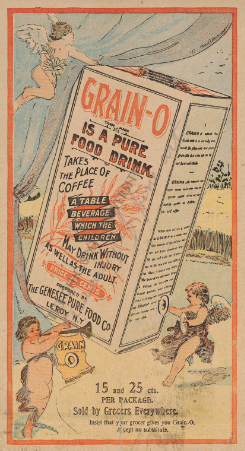
Orator F. Woodward produced not only Jell-O, but also Grain-O, a “roasted cereal coffee ‘for those who can’t drink tea and coffee.’” Grain-O sales apparently paid for the development and promotion of Jell-O. This product intrigued me, mostly because Grain-O conjures up images of both plumbing products and an overabundance of fiber in the diet. To the library!


I found the following advertisement for Grain-O in “A Collection of Delectable Recipes, Tried and True” published by the Unitarian Church out of Waterville, ME in 1898.

I have reproduced the format to the best of my ability.

GRAIN-O

…is a…

PURE FOOD DRINK

It takes the place of coffee. It is a table
beverage which the children may drink
without injury, as well as the adult. Grain-O
looks and tastes like coffee, but it made
from pure grains, and the most delicate
stomach receives it without stress.

It’s Nourishing and Strengthening.

A lady said: “The first cup I used I did not
like it, but after using it a week nothing
could induce me to go back to coffee.”


Try GRAIN-O Try GRAIN-O

_________
Prepared by the
Genesee Pure Food Company

Le Roy, New York

15c and 25c per package Sold by all grocers.


Ah, Grain-O. Try it and you won’t like it, but eventually you’ll get used to the taste and become addicted to it! Try it! TRY IT!

Grain-O was apparently extremely popular for a time, as apparently sentiment against coffee was high, and people wanted their children to be able to drink bitter things.

From the New York Times, on May 24, 1897, “the great $50,000 damage suit instituted by a Michigan Cereal Company against the Genesee Pure Food company is at an end. They settled it and took it out of court for the ridiculously small sum of $500, and, as a practical result, Grain-O is in greater demand than ever. The new plant, only just completed, is to be duplicated, so that not only the old friends of the delicious food drink, which completely takes the place of coffee, but the new friends it is making every day, can be supplied. The beverage which the children, as well as the adult, may drink with benefit, will be furnished in unlimited quantities. Suits may come and suits may go, but Grain-O goes on forever—N.Y. Mail and Express.”

The above is not an advertisement, but a news release, ever so slightly biased.

Grain-O was one of many cereal based coffee substitues on the market at the time. The Publications of the Maine Agriculture Experiement Station published in 1901 lists several which it subjected to analyses of solubility and nutritional content (pages 103-105).
Postum Cereal (Postum Cereal Company, Battle Creek Michigan)
Caramel Cereal (Battle Creek Sanitarium Health Food Company, Battle Creek, Michigan)
Golden Grain Coffee (John A Tibbs, Buffalo, NY...not actually coffee)
Old Grist Mill Entire Wheat Coffee (Potter and Wrightington, Boston, Mass...not actually coffee)
Grain-O (Genesee Pure Food Company, Le Roy, NY)
Dr. Johnson's Cereal Coffee (Johnson Food Educator Food Store, Boston, Mass...not coffee)
Mo-Ko (John F. Bauer and Company, Mt. Morris NY)
Don't these all just sound scrumptious!
Postum Cereal drink was actually sold until 2007, sometimes with the aid of Mr. Coffee Nerves!
Next stop...the Woodward family and the cereal wars.

On the first day

The purpose of this blog is to serve a repository for the major and minor American historical facts I stumble upon in my reading and research. It is an entirely selfish pursuit, a place to store the funny facts I find in libraries, on ye olde internets, and in my travels. For the most part, I will be focusing on the northeastern united states because, well, there’s just more “history” to be found there. I’m also a New England gal, born and raised, and proud of it.

Typically, I will write in the same manner in which I ramble to my family and friends. I will start at one point, and end somewhere. It may be somewhere completely different. I’m just going to write until I get bored.

This is not a political blog. Events will be described simply as they happened and without judgment (as much as I can possibly withhold it). Political parties and issues will obviously be discussed. But I won’t be stating my unsolicited opinion on the politics involved.

I will include folklore as it relates to descriptions of actual locations and events, but I will not present these stories as fact in and of themselves.

I spend the majority of my formative years in Winsted, CT, and as a result many of my early entries will be about or mention the history of Winsted and the Litchfeild county area. I will branch out as I go on, I promise.

I love history. I do not take it all terribly seriously. For thousands of years, man kind has been ridiculous. The entries in this blog will often reflect that fact.

I hope you enjoy this as much as I will.


Start point 1: The Greenbacks

I actually started looking into the Greenbacks after reading a piece on the history of the Winsted, CT press. The Winsted Press, according to William Jamieson Pape’s “The History of Waterbury and the Naugatuck Valley (page 426), was for sometime a “Greenback” supporting paper, endorsing 3 consecutive Greenback candidates for the presidency.

History Channel website! Make this easy for me!

*poof*

http://www.history.com/encyclopedia.do?vendorId=FWNE.fw..gr090200.a#FWNE.fw..gr090200.a

Why thank you History Channel website…oh, there’s something stuck in your…ah, there it is.

*Cough*

http://www.history.com/encyclopedia.do?articleId=210911

*hack*

http://www.history.com/encyclopedia.do?articleId=219636

Oh good lord, I’ve immediately stepped into a pile not days into starting my non-political blog. Well, let’s play it safe and stick to the trivia!

Okay, square one…the first “Great [American] Depression” took place in the early 1870s. During this time there were still a lot of farmers in this country, and they were a significant political force, though not necessarily the majority they once were. We’re still fairly fresh out of the civil war, the economy is in the turlet, and the farmers, bankers, and manufacturers are freaking out. In 1874, the Greenback party was born in Indianapolis.

The Greenbacks advocated a purely government controlled monetary system, as opposed to money being controlled and largely issued by the banks. During the civil war, the government had issued ‘greenbacks,’ money assigned value by federal control rather than the banks, and backed by the government rather than by gold. They believed that continuing to issue greenbacks would keep more money in circulation, reviving the economy and making it possible for farmers and manufacturers to pay off debts, and keeping the value of goods and services out of the control of the banks.

Winsted being a town divided between manufacturers, laborers and farmers, it makes sense that there would be some popular support there for the Greenbacks and their bastard children, the Greenback-Labor party of farmers and laborers. Neither party survived long under the “Greenback” name, but their values were a major contributor to the American labor movement.

The Greenbacks' (just Greenbacks) first and only candidate for the presidency was Peter Cooper. Who was he? New Yorkers should know!
http://en.wikipedia.org/wiki/File:Pet-Ed_Cooper.jpg

Peter Cooper was an inventor, philanthropist, manufacturer, and strange beard enthusiast who is perhaps best known to New Yorkers as the man behind Cooper Union, where you can go be a piano genius or some such thing for free. Peter Cooper village was names after him as well (and not, as is popularly believed, after this guy: http://www.petercoopermusic.com/) He was one of those good guy progressive types with the kind of ideas you still here good guy progressive types talking about today. He was a champion of reform in the way American Indians were treated, and an advocate for their rights. He was an abolitionist, natch. He pushed for the free education of working class men and WOMEN (educating the women…I’ll have to do an entry on the dangers of that). He was also a critic of the debt based economy (gee, good thing that went away!) and the gold standard. He was a pretty well known and important figure in American History, ladies and gents. But he got beat out by Rutherford B. Hayes, who I imagine fewer New Yorkers are able to identify.

Peter Cooper had only one son, Edward Cooper, who would go on to become mayor of New York City for one term. Cooper was succeeded as mayor by his business partner, Abram Stevens Hewitt. Edward Cooper, Hewitt, and Samuel Tilden (who had run against Edward’s father Peter for the presidency, fancy that) had all banded together to take down the Tweed Ring. Hewitt had joined Peter and Edward Cooper’s iron making business, and produced gun barrel iron for the government at no profit during the civil war. He also contributed to Cooper Union’s endowment. When he ran for mayor, one of the men he defeated was Theodore Roosevelt. Neat! (this is all according to Encyclopedia Britannica).

Edward Cooper proceeded to then do nothing. Well, historically. Poor Edward lived out his days as an extraordinarily wealthy and influential footnote in his father’s story. According to “Inside Greenwich Village,” by Gerald W. McFarland (pages 83-84), Cooper enjoyed a sizable mansion on Washington Square Park, the only industrialist maintaining such a prestigious address at the time. Edward, like his father, was dedicated to the education of the working class (I refrain here from discussing the irony of that commitment). He maintained one of the largest house staffs in the area. Cooper lived with his daughter, son in law, and grandchildren, and lots of white servants as black servants were out of fashion following the civil war. Irish was the new black!

Speaking of the Irish, Cooper and Hewitt were preceded followed as mayors of New York by an Irishman, William Russell Grace. Grace was the first Irish Catholic mayor of NYC. http://memory.loc.gov/learn/features/immig/irish7.html

Grace was, along with the Coopers, an opponent of the Tweed group.

To return to Peter Cooper and get away from politics for a bit…Peter Cooper invented Jell-O.

http://inventors.about.com/library/inventors/bl_tom_thumb.htm

The Jell-O museum:
http://www.jellomuseum.com/index.html

To be continued!